
Best Franchises to Invest in Pakistan: How to Compare Your Options
The right franchise for you is one whose full cost fits your budget with a reserve, whose products suit demand near your site, whose daily operation you can run, and whose support is promised in writing. Use the same checklist for every brand and settle weak points before you pay.
Key takeaways
- Compare the full cost to open, including fit-out, deposits and working capital — not just the franchise fee.
- Check demand yourself at your actual site, and speak to current franchisees without the brand present.
- Pakistan has no franchise-specific law, so have a lawyer review the agreement and confirm the trade mark is registered.
There is no single list of the best franchises in Pakistan that suits every investor. A franchise is a good investment for you when its full cost fits your budget with money to spare, people near your chosen site want what it sells, the daily operation is something you can run, and the brand gives real support in writing. This guide shows you how to compare franchise opportunities in Pakistan on those points, so you can judge each brand with evidence instead of advertising.
A franchise means you run your own outlet using another company's name, products and methods, in return for fees. You own the risk of the outlet. The brand owner (the franchisor) provides the system. Nothing in this guide is a promise of profit, and no franchise is risk-free.
What makes a franchise worth considering?
Five things matter more than the brand's popularity. Look at each one before you compare names.
Total investment
The franchise fee is only one part of the cost. Ask the brand for a written estimate of everything needed to open: the fee, shop fit-out, equipment, signage, security deposit and advance rent, first stock, opening marketing, and working capital (the cash that pays salaries, rent and bills while sales build up). Keep a separate reserve for slow months. Our franchise cost calculator helps you add these up, and the budget pages show listings by investment range.
Real local demand
A brand that is busy in one city may be quiet in another. Demand depends on who lives, works or studies near your site, how often they would buy, and what they can comfortably spend. Visit at the hours your customers would come, count people yourself, and note competing shops nearby.
The operating model
The operating model is how the outlet works every day: opening hours, number of staff, kitchen or service steps, deliveries and stock. Ask for a typical day's schedule and a staffing plan. A simple model with fewer moving parts is often easier for a first-time owner to manage.
Brand support
Good support is specific. Ask what training you and your staff get, who helps at opening, how often someone from the brand visits, how supplies reach you, and who you call when something breaks. Get these answers in writing.
Owner fit
Be honest about your time, skills and patience. Some franchises need the owner on site most days. Others suit an owner who manages a manager. A model that matches your life is more likely to be run well.
A comparison framework you can use in any sector
Use the same questions for every brand, then note what changes by sector. The table below is a starting point, not a rule.
| Sector | What usually drives the cost | What to check closely |
|---|---|---|
| Food and beverage | Kitchen equipment, exhaust, gas and power load, fit-out | Food authority licence, supply chain, waste and staff turnover |
| Retail | Stock, shelving, frontage and rent | Who owns unsold stock, return rules, delivery schedule |
| Education | Space, furniture, trained teachers | Curriculum support, teacher training, parents' fee levels nearby |
| Services (beauty, fitness, repair) | Equipment, skilled staff, interior | Staff training and certification, booking systems, product supply |
| Brand distribution | Stock, transport, credit to retailers | Territory, margins, payment terms and returns |
Browse current listings by sector, for example food franchises, retail franchises, beauty and salon franchises and distribution opportunities. You can also put up to four brands side by side with our franchise comparison tool.
Questions to ask before you invest
Due diligence means checking the facts yourself before you sign or pay. Ask every brand these questions and keep the answers in writing.
- What is the full cost to open, item by item, and what is not included?
- What ongoing fees will I pay — royalty, marketing fee, software or other charges — and how is each one calculated?
- Can I speak to current and former franchisees without the brand present?
- Is the brand name registered as a trade mark in Pakistan, and in whose name?
- Which suppliers must I use, and can prices change during the agreement?
- Will I have a protected area, and how is it defined?
- How long is the agreement, how is it renewed, and what happens if I want to sell or close?
- What training and opening support is included, and for how long?
- What permits and registrations does this business need, and who arranges them?
Our due diligence checklist lets you track these answers for each brand.

Pakistan-specific points to check
Information in this section was checked on 9 November 2026. Rules and rates change, so confirm them with the relevant office before you rely on them.
City and neighbourhood
The same brand can perform very differently in two areas of one city. Customers in an office district, a university area and a family residential block have different hours and spending habits. Compare rent with the likely number of customers, not just with the rent next door. Our guide to choosing a franchise location explains what to observe on site, and the guide to upfront commercial renting costs covers deposits and advance rent.
Purchasing power
Prices across Pakistan have risen sharply in recent years, and that affects what customers spend on eating out, shopping and services. Check the latest inflation figures from the Pakistan Bureau of Statistics and ask the brand how its prices compare with similar local options.
Utilities and backup power
Ask the landlord for the sanctioned electricity load and check whether the outlet needs three-phase power, gas, water or a generator or solar backup. Commercial electricity tariffs are set through the National Electric Power Regulatory Authority (NEPRA) process and change from time to time, so put current bills, not old ones, into your costs.
Supply chain
Find out where stock or ingredients come from, how often deliveries arrive in your city, and what happens if a delivery is late. For imported items, ask how the brand handles exchange-rate changes.
Staffing
Ask how many people the outlet needs per shift, what the brand pays its own staff, and how long training takes. Staff turnover can raise costs if the brand's training is slow.
Licences, tax and the law
Pakistan has no specific franchise law. The relationship between brand and franchisee is governed mainly by the Contract Act 1872, so the written agreement carries most of your protection (International Bar Association). Ask a lawyer to review it before you sign — our franchise agreement guide lists the clauses to look at.
- Trade mark: ask for proof that the brand's name is registered with IPO-Pakistan, the national intellectual property office.
- Foreign brands: sending franchise fees abroad needs approval under State Bank of Pakistan foreign exchange rules (Dentons, December 2023). Ask an international brand to confirm this is in place. Check current rules on the State Bank of Pakistan website.
- Sales tax on services: franchise services are taxed by the provinces, for example by the Punjab Revenue Authority and the Sindh Revenue Board. Ask a tax adviser how this applies to your fees.
- Food businesses: in Punjab, food outlets need a Punjab Food Authority licence, which is valid for one year (PFA licensing). Other provinces have their own food authorities.
Franchise comparison checklist
Score each brand from 1 (weak) to 5 (strong) on every line. A low score is a question to settle in writing, not always a reason to walk away.
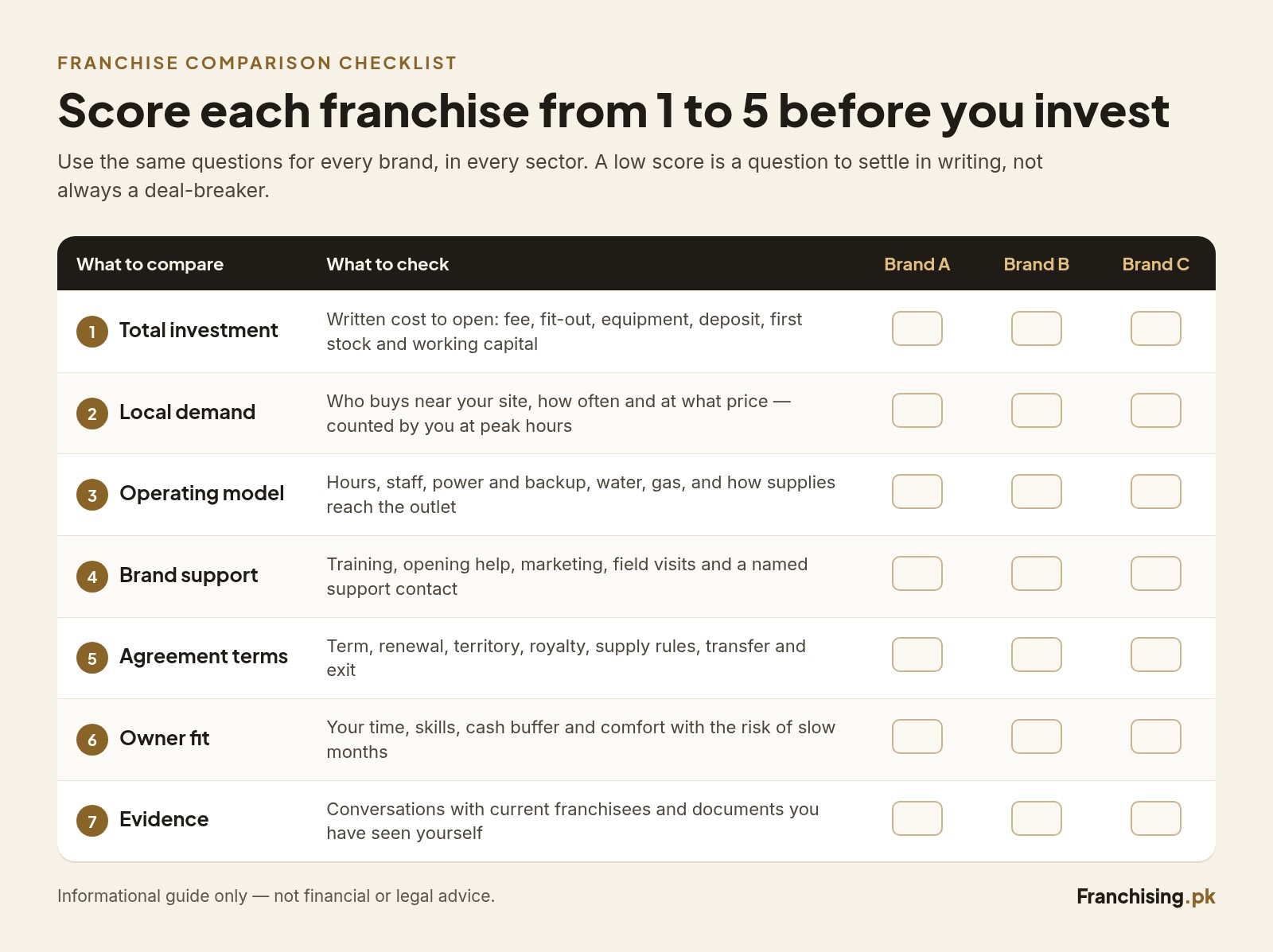
| What to compare | What to check | Brand A | Brand B | Brand C |
|---|---|---|---|---|
| Total investment | Written cost to open, plus working capital | |||
| Local demand | Your own customer counts at your site | |||
| Operating model | Hours, staff, utilities and supplies | |||
| Brand support | Training, opening help, visits, named contact | |||
| Agreement terms | Term, renewal, area, fees, transfer and exit | |||
| Owner fit | Your time, skills and cash buffer | |||
| Evidence | Franchisee conversations and documents seen |
Common mistakes to avoid
- Choosing by fame alone. A well-known name does not guarantee sales at your site.
- Counting only the franchise fee. Fit-out, deposits and working capital often cost more.
- Trusting average sales figures without proof. Ask for documents and speak to owners yourself.
- Signing a lease before the brand approves the site. If the agreement requires brand approval of the premises, get it in writing first.
- Skipping the lawyer. With no franchise-specific law, the agreement is your main protection.
- Investing money you cannot afford to lose. Keep a reserve and do not borrow beyond what slow months can carry.
Conclusion and next step
The best franchise in Pakistan for you is the one that passes these checks at your budget, in your city, on your site. Shortlist two or three brands, put each one through the checklist above, and settle every low score in writing before you pay.
To start, browse franchise opportunities, estimate your costs with the franchise cost calculator, and test your numbers with the payback estimator. A brand appearing on Franchising.pk is not a recommendation; every investor should do their own checks.
This article is for general information only. It is not financial, legal or tax advice. Speak to a qualified lawyer, accountant or tax adviser before you invest.
Sources and further reading
All links were checked on 9 November 2026.
- International Bar Association — Franchising in Pakistan (June 2023)
- Dentons — Franchising in Pakistan (December 2023)
- State Bank of Pakistan — official website
- Intellectual Property Organization of Pakistan — IPO-Pakistan
- Punjab Revenue Authority — frequently asked questions
- Sindh Revenue Board — official website
- Punjab Food Authority — apply for a licence and licensing information
- National Electric Power Regulatory Authority — NEPRA
- Pakistan Bureau of Statistics — PBS
Photos: Zain Ali on Pexels (cover) and Pexels contributors (in-article), used under the Pexels licence.
Related articles
- Choosing a Franchise Location in Pakistan: What to Check on Site — A busy street is not enough. Check access, customer patterns, power, signage, delivery routes and brand approval before choosing a franchise site.
- How to Choose Your Ideal Franchise in Pakistan — A step-by-step framework to evaluate franchise opportunities in Pakistan, from self-assessment to financial checks and legal review.
- 5 Investment Tips for First-Time Franchise Buyers in Pakistan — Practical, honest advice on budgeting, location, unit economics and due diligence before buying your first franchise in Pakistan.
- Franchise Due Diligence Checklist — A practical checklist for reviewing disclosure documents, unit economics, fees, territory, lease, training and exit terms before you invest.